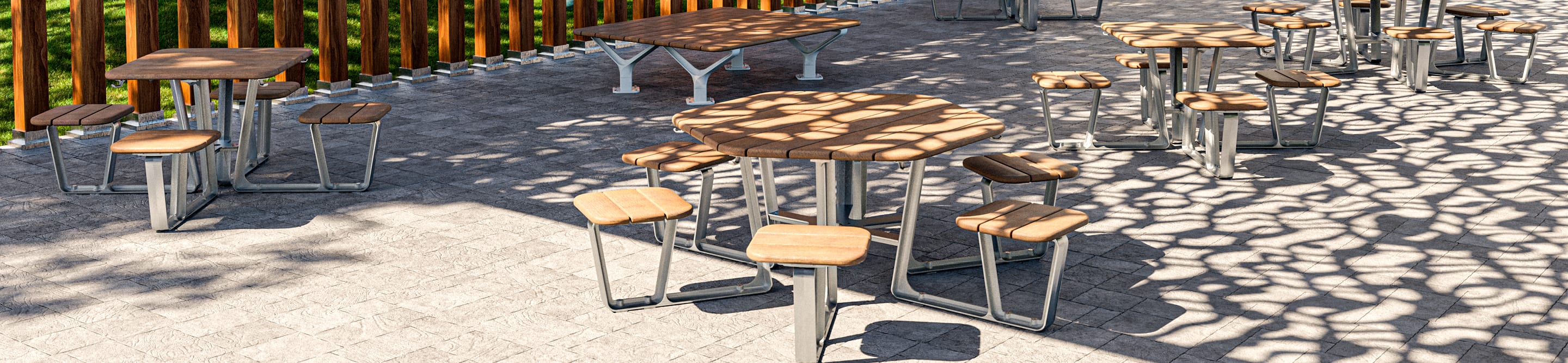
The best public spaces feel intuitive. People instinctively understand where to move, where to pause, where to gather and where to find a moment of their own.
That ease is the result of considered design. The selection and placement of public space furniture can shape how people experience a place, influencing movement, comfort, connection and how long they choose to stay.
Across parks, campuses, streetscapes and mixed-use developments, public space furniture has a role beyond simply furnishing a space. At its best, it responds to how people naturally use their surroundings, helping create places that are comfortable, inclusive and purposeful.
Key takeaways
Start with people, not products.
Think about how the space will actually be used.
Build accessibility into the layout early.
Pay attention to shade, circulation and climate.
Choose furniture that can handle everyday use.
Plan seating, tables and amenities as one space.
Start With the People Who Will Use the Space
When deciding how to design public spaces, it is tempting to start with the furniture. How many benches are needed? Where should the tables go? Which products suit the look of the project?
Those questions matter, but they come later. First, it helps to understand who is likely to use the space and what they will need from it.
A neighborhood park may need places for older visitors to stop and rest, seating near play areas for parents and tables for families. A university campus may need a mix of quiet seating, group tables and places where students can eat or work between classes.
The same space can also serve people who only stop for a few minutes and others who stay much longer. Providing different public space seating solutions gives people more choice in how they use the area.
Community need | Possible design response |
A quick rest | Seating along common walking routes |
Longer stays | Seating near shade or activity |
Socializing | Grouped or facing seats |
Quiet time | More separated seating |
Inclusive use | Accessible layouts with clear space |
The aim is not to control how people behave. It is simply to make it easier for different people to use the same space in ways that suit them.
Design Around How People Use the Space
Once the users are understood, the next step is to think about what they are likely to do there.
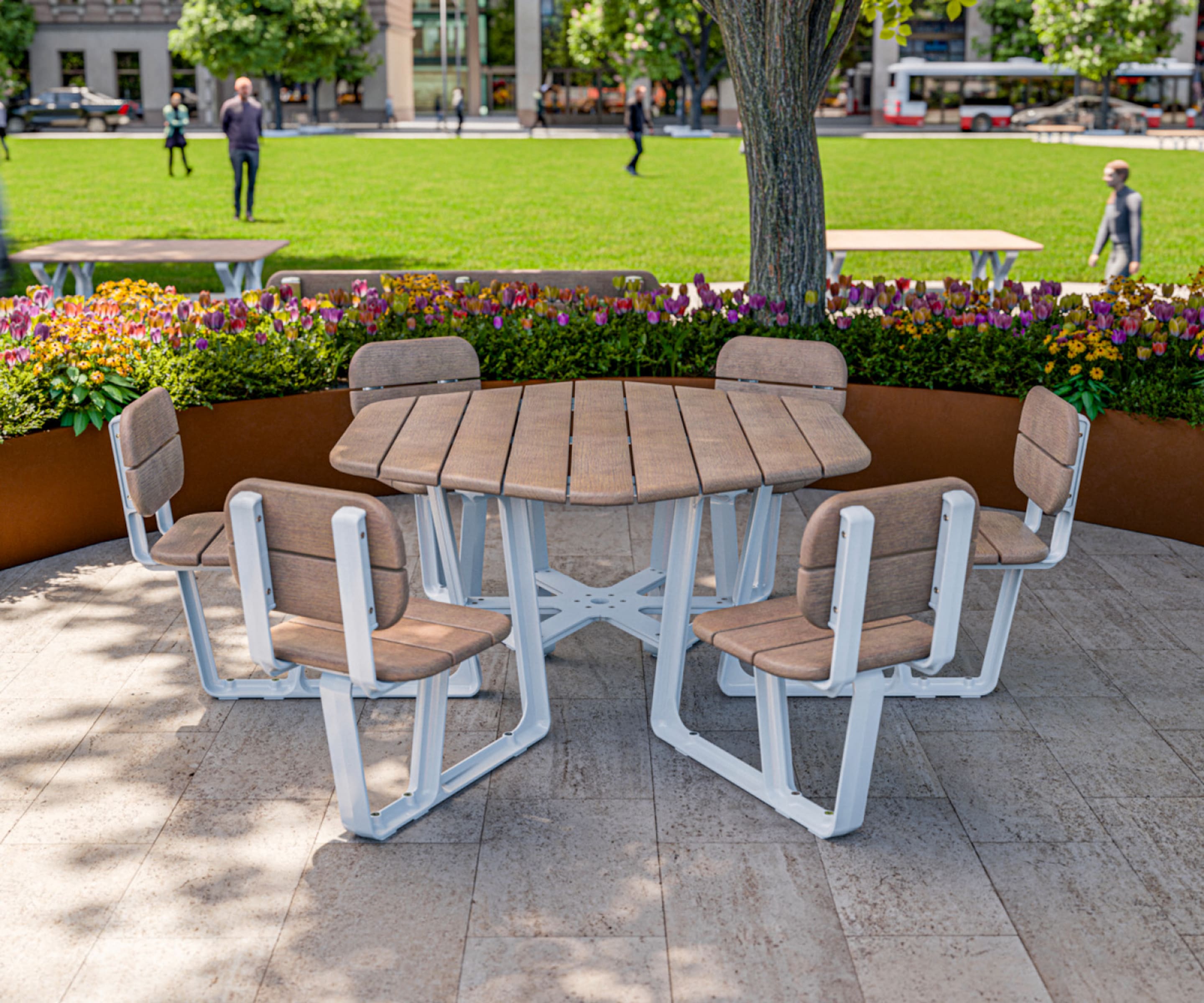
Benches can create natural places to pause along a path. Grouped seating can make conversation easier, while tables can support lunch, study, outdoor meetings or a longer break during the day. In spaces designed for these longer stays, botton+gardiner’s public table settings can be used alongside seating to create more useful gathering areas.
Where the furniture sits matters just as much as what is selected. A table placed in an exposed corner may not get much use, while the same table near shade, planting or an active part of the site can quickly become a popular spot.
A few simple questions can help:
Where do people naturally stop?
Which areas already attract activity?
Where is there useful shade?
Can people move around the furniture easily?
Is there a mix of social and quieter places to sit?
Good public spaces usually offer a choice. Not everyone wants to sit at a communal table, and not everyone wants to sit alone.
Build Accessibility and Comfort Into the Layout
Accessibility should be considered from the beginning of a public-space project, not added once the furniture and layout have already been decided. Under the Americans with Disabilities Act (ADA), public environments need to provide equitable access for people with disabilities, which means designers need to think about both the furniture itself and the space around it.
For seating and table areas, that can include:
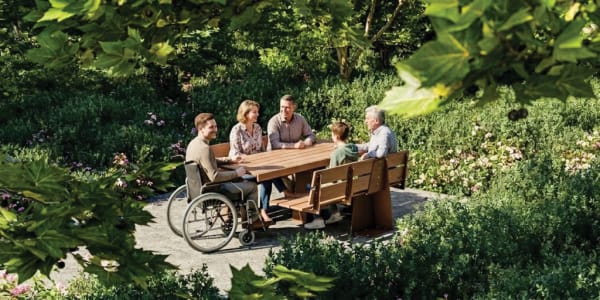
Clear wheelchair spaces beside seating
Accessible routes to and around furniture
Suitable approach space at tables
Appropriate knee and toe clearance
Seating arrangements that allow wheelchair users to sit with companions
Backrests and armrests where they help support easier use
Enough circulation space to avoid creating barriers
The wider layout matters just as much as the individual product. A table may be designed with accessibility in mind, but poor placement, blocked routes or insufficient surrounding space can still make the area difficult to use.
botton+gardiner also offers a dedicated range of ADA products for projects where accessible furniture is required. These products still need to be considered as part of the wider layout and against the specific requirements that apply to the project.
Comfort should be considered alongside accessibility. Shade, sightlines, spacing and proximity to activity all influence whether a seat or table is genuinely easy and enjoyable to use, so the best layouts consider both access and everyday experience.


Choose Furniture That Can Handle Everyday Use
Public furniture needs to perform in the conditions it is specified for. From sun, rain and snow to dirt, frequent cleaning and heavy daily use, the demands of the site can have a significant impact on how furniture performs and looks over time.
That is why choosing commercial outdoor furniture is not just about appearance. The site and local climate need to be part of the decision too.
Before specifying, it is worth considering:
How will the material respond to UV and weather?
Is the furniture easy to clean?
Can damaged parts be repaired or replaced?
Will water drain properly?
How will the finish hold up in a high-traffic area?
What maintenance will be needed over time?
For some projects, snow and freeze-thaw conditions will be a major concern. In others, heat, coastal air or strong UV exposure may be more important.
botton+gardiner combines Australian design experience with North American manufacturing in Dallas, Texas. For U.S. architects, landscape architects, municipalities and developers, that means working with a trusted brand focused on furniture for real commercial and public environments.
Think Beyond Seating and Tables
A public space is rarely successful because of one great bench or table. It is usually the result of several elements working well together.
Seating and tables may do most of the heavy lifting, but planting, shade and waste management also shape how comfortable and practical the space feels. botton+gardiner’s commercial planters can help introduce planting and define different zones, while a double trash can can support waste and recycling in busier areas.
Umbrellas can also make a noticeable difference where outdoor seating is exposed. Around tables, dining areas and open plazas, shade can make the difference between a space people pass through and somewhere they are happy to stay.
Public element | What it adds to the space |
Seating | Places to rest, wait and socialize |
Tables | Space for dining, working and gathering |
Planters | Planting and clearer spatial definition |
Trash and recycling | Cleaner shared areas |
Umbrellas | Shade and greater outdoor comfort |
Looking at these elements together helps create a space that feels planned rather than assembled piece by piece.

A Practical Checklist for Public Furniture
Before signing off on a furniture plan, it is worth running through a few simple questions:
Who is using the space? Think about age, mobility and group size.
What are people doing there? Resting, eating, working, waiting or gathering?
Can everyone use it comfortably? Check clear space, routes and seating positions.
Is the furniture in the right place? Consider shade, views and nearby activity.
Can it handle the local climate? Think about heat, UV, rain, snow and corrosion.
Is it easy to look after? Cleaning and repair should be part of the decision.
Does everything work together? Seating, tables, planters and shade should feel connected.
These checks keep the focus on how the space will work in real life, not just how it looks on a plan.
Create Public Spaces That Work for the People Using Them
The best public spaces usually get the basics right. People can find somewhere comfortable to sit, move through the area without unnecessary obstacles and choose whether they want to gather with others or spend time on their own.
Furniture plays an important role in making that happen, but it works best when it is considered alongside accessibility, shade, planting, circulation and the practical demands of the site. When those decisions are made together, the result is a space that feels more useful and more welcoming from the start.
As a trusted public-space furniture brand for the North American market, botton+gardiner offers seating, tables, planters, trash and recycling solutions, ADA products and umbrellas for commercial and community settings. Explore the full range of public space furniture to find solutions designed for the way people actually use outdoor spaces.